Computational Drug Discovery, In-House

Sixteen tools. One lab bench. From molecule to mechanism, without leaving your own hardware.

Growdea builds the AI/ML and molecular-simulation software that used to require a bioinformatics team, a cluster, and months of setup — and puts it behind a graphical interface a wet-lab scientist can run in an afternoon. Docking, MD, generative chemistry, ADMET and toxicity, in one connected suite.
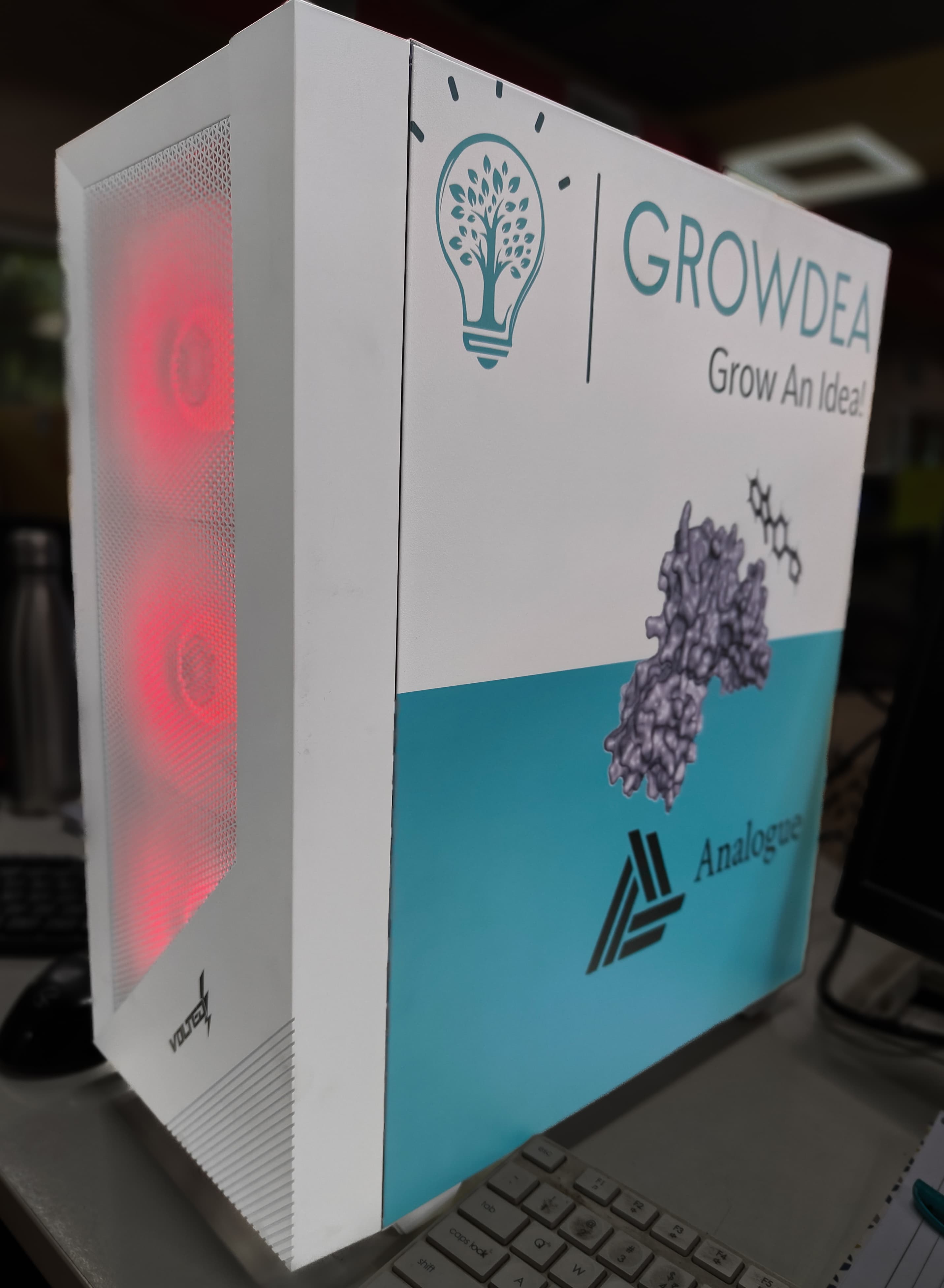
Growdea Analogue GPU workstation, delivered on-site with a lifetime hardware + software license
16
tools across 2 solution areas
700K+
fragment library (iFrag)
2.4M+
toxicity graph relationships
100%
offline / on your own hardware
Why scientists switch

Built so the computation gets out of the way

Growdea's own positioning, condensed from its client-facing benefits brief — every point below is a claim the company makes in writing, not marketing gloss we added.

No command line, anywhere

Docking, MD setup, trajectory analysis and QSAR modelling are all point-and-click. Force fields, solvation models and protein prep are automated — the interface is built for experts and first-time computational users alike.

Runs fully offline

Deployed on your own GPU workstation or server. Nothing proprietary — targets, compounds, sequences — ever leaves the building.

Hardware included

Ships with a GPU-enabled workstation or scalable cluster, 1-year hardware warranty, and a lifetime license on both the hardware and the software.

No renewal treadmill

Lifetime plan, free updates, no yearly or 3-yearly repurchase cycle for new features.

End-to-end pipeline

Virtual screening → docking → MD → ADMET → AI/ML prediction, with a direct hand-off into wet-lab validation.

A team, not a ticket queue

48-hour max response time, 40 hours/year of committed support, a 2-day onsite training workshop, and an India-based team with no time-zone gap.

Publication support

Assistance toward your first research publication using the platform, with co-publication and joint-project opportunities.

Validated before you buy

Every algorithm has already been run against real client problems through Growdea's fee-for-service work before it ships as product.

Platform 01 — The Analogue Suite

From molecule to mechanism, all in one platform

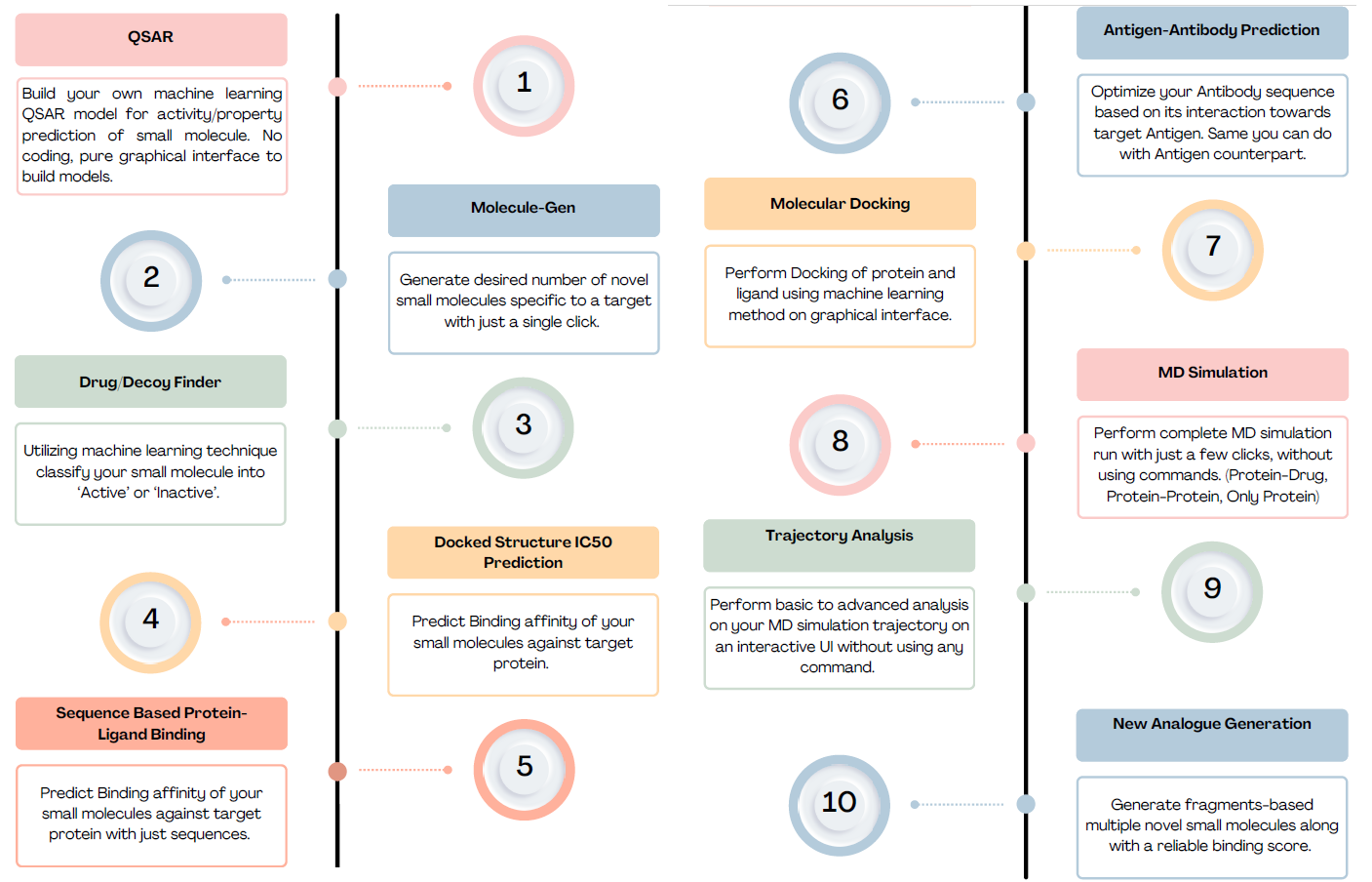
Twelve connected modules covering the full computational drug-discovery loop — molecule generation, docking, binding-affinity prediction, molecular dynamics, enhanced sampling, and fragment-based optimization — sharing one interface and one file format, so output from one module is input to the next.

Analogue platform workflow overview across all modules
QSARAna module

01QSARAna — "QUASAR"

ScienceNo-code, ligand-based QSAR/ML modelling — feed in SMILES plus activity data and build a predictive model from a library of 1,500+ chemical descriptors.
EasePoint-and-click model building — linear regression through random forest and neural nets, zero scripting.
USP1,500+ descriptors and a full algorithm menu in one no-code environment.
Manual available on request
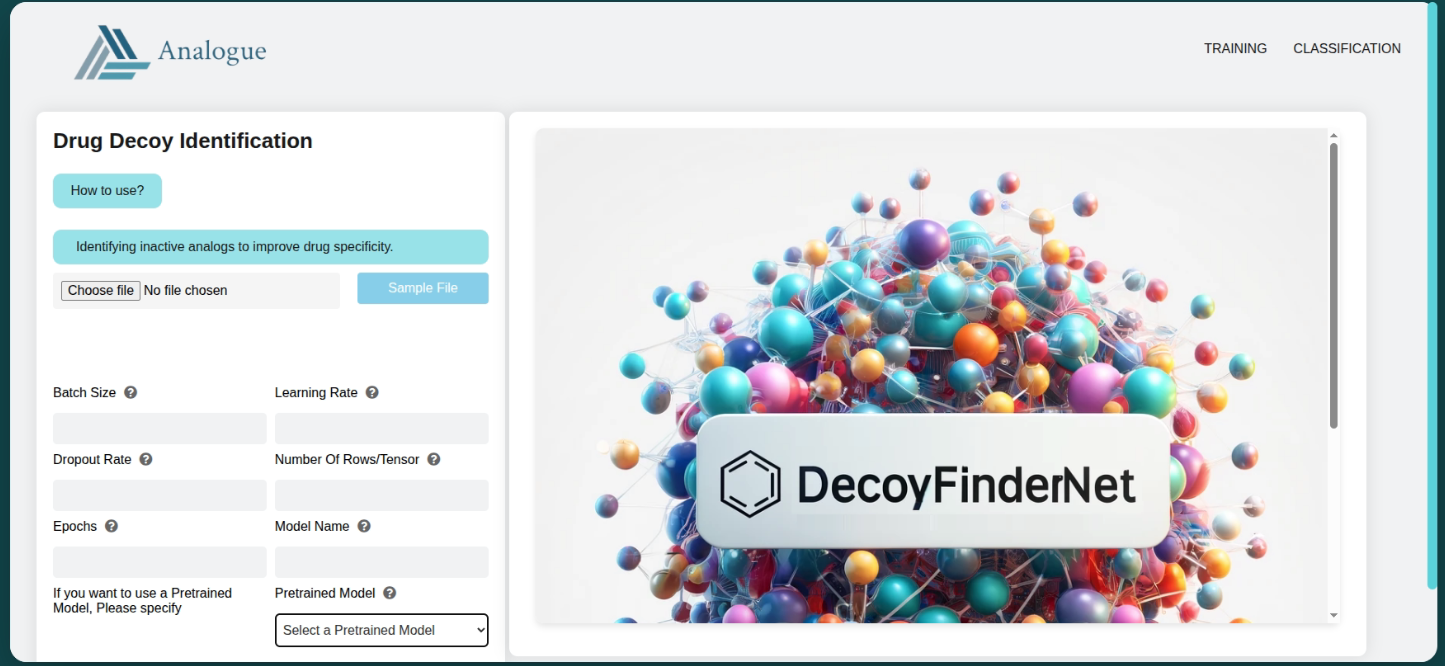
DecoyFinder-NetAna live interface

02DecoyFinder-NetAna

ScienceGraph Neural Network classifier, trained on the DUDE decoy database, that separates true active binders from inactive decoys in a screening library.
Ease~102 pretrained models ready to use out of the box, or retrain on your own actives/decoys.
USPSample model accuracy of 0.944 — reported with plotted validation, not a black-box score.
Manual available on request
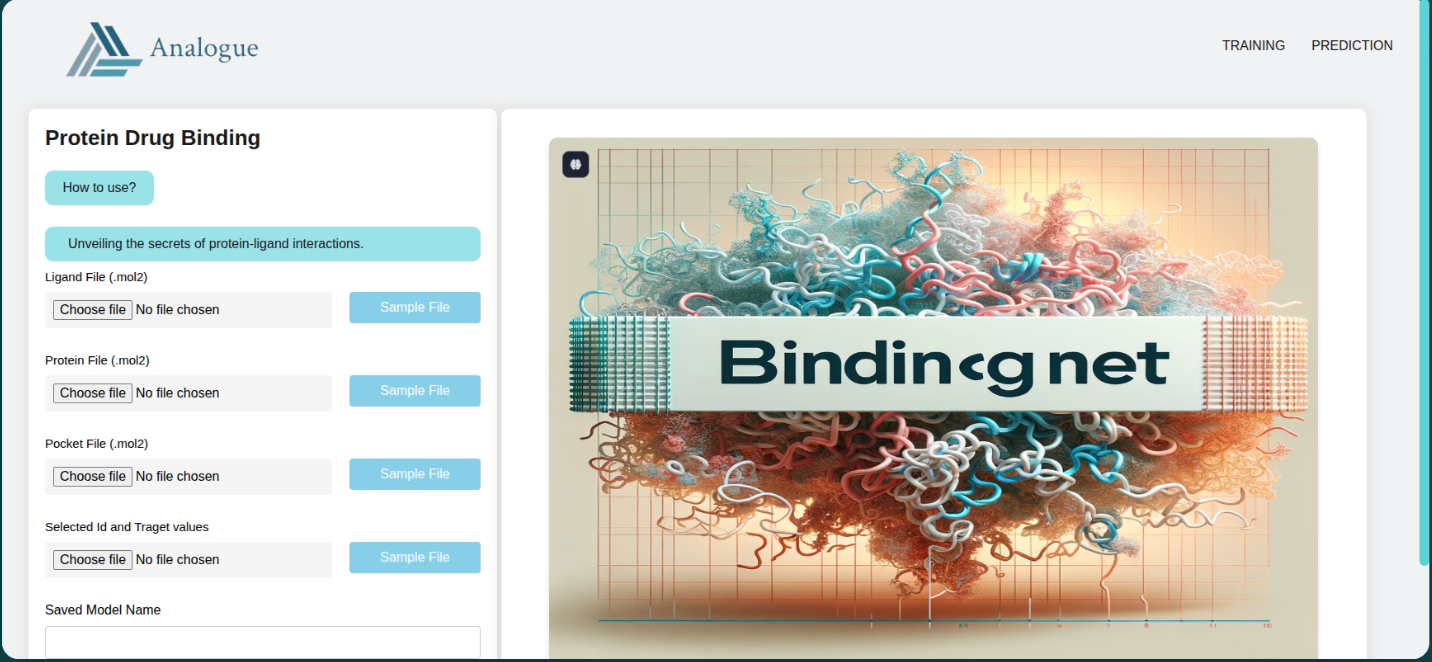
Binding-NetAna live interface

03Binding-NetAna

ScienceStructure-based binding-affinity (IC50/Kd) predictor trained on protein–ligand docked complexes, using full binding-pocket context.
EaseUpload ligand, protein and pocket files (.mol2) and predict — pretrained or retrainable on your data.
USPReads the 3D pocket, not just sequence, for a more mechanistically grounded affinity call.
Watch it in action
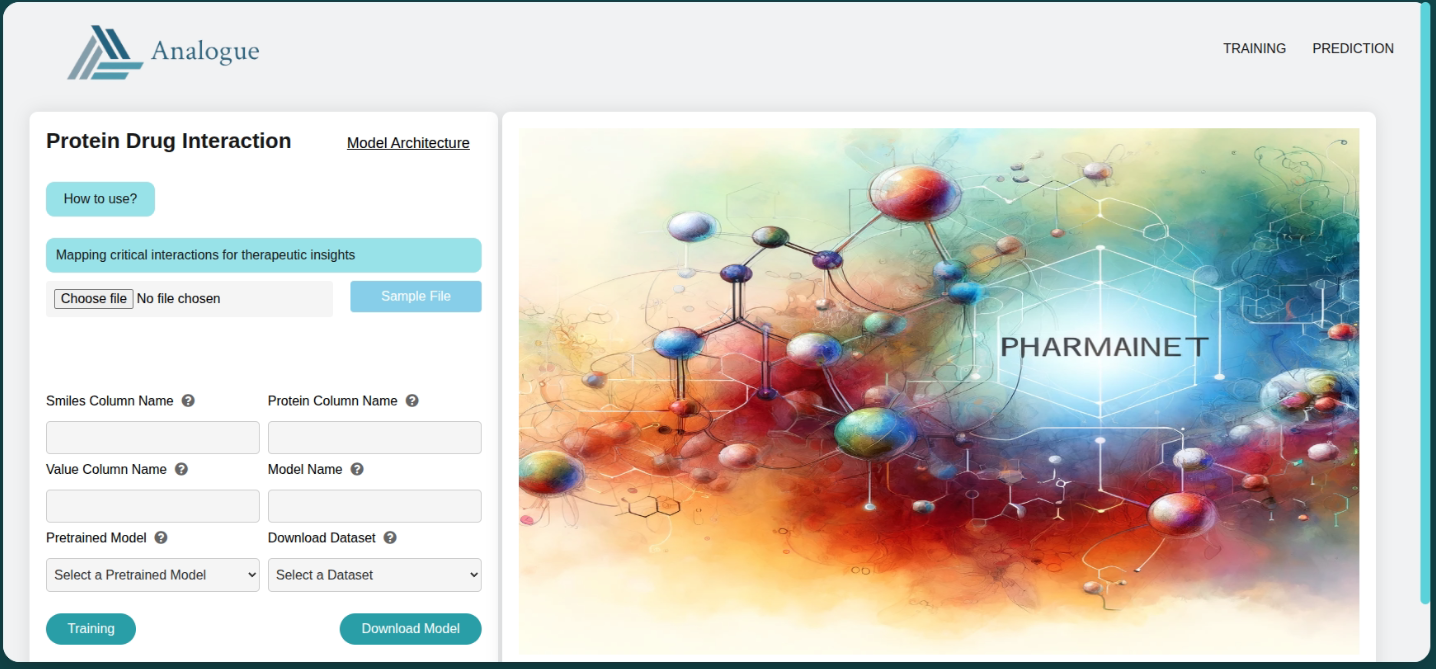
Pharmal-NetAna live interface

04Pharmal-NetAna — "PharmaINET"

ScienceSequence-only protein–drug compatibility predictor — no 3D structure required — using two independent descriptor sets.
EasePoint at your protein-sequence and SMILES columns; the model trains and returns evaluation metrics automatically.
USPSample run: R² = 0.675, correlation = 0.829 — useful precisely when you don't have a docked structure yet.
Watch it in action
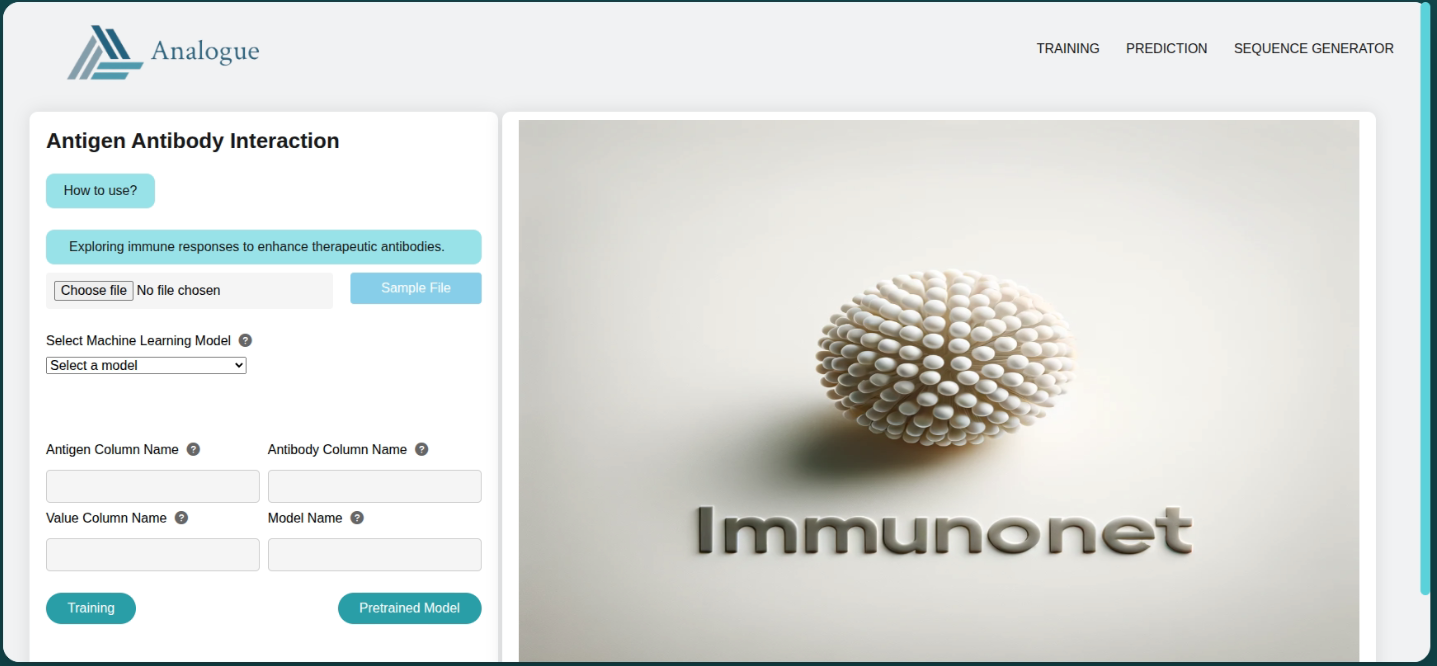
Ag-AbAna / ImmunoNet live interface

05Ag-AbAna — "ImmunoNet"

SciencePredicts antigen–antibody binding affinity (Kd) from sequence, with a built-in peptide/mutation generator to optimize antibody sequences.
EaseSingle-pair or batch mode; use the pretrained model or train your own.
USPSample run: R² = 0.613, correlation = 0.818 — one of the few Analogue-class tools purpose-built for biologics/antibody optimization.
Watch it in action
DockAna module

06DockAna

ScienceProtein–ligand docking engine combining ML-assisted and physics-based scoring.
EaseAccepts a PDB ID, PDB file, ligand file, or a plain SMILES string; real-time visualization; single or batch docking against multiple targets.
USPReturns the top 20 ranked poses per run and can batch-process several targets in one job.
Watch it in action
SimAna module

07SimAna — "Growdea MD Insight"

ScienceFull GROMACS-based molecular dynamics pipeline for protein–ligand, protein–protein/peptide, or protein-in-water systems.
EaseStructure prep → solvation → ionization → minimization → NVT/NPT equilibration → production, guided end-to-end in a few clicks — no manual force-field scripting.
USPRemoves the steepest part of the MD learning curve: the whole setup chain lives in one workflow.
Watch it in action
TrajectaAna module

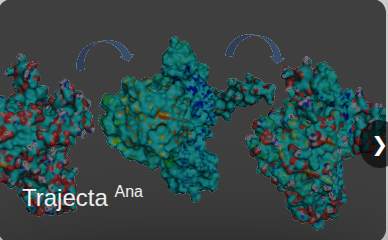
08TrajectaAna

SciencePost-MD trajectory analysis — RMSD, RMSF, hydrogen bonding, SASA, radius of gyration, binding energy, PCA / free-energy landscape.
EaseBatch-plots multiple XVG outputs at once and auto-generates a PDF analysis report.
USPStructural, energetic and conformational-landscape analyses in one module instead of five separate scripts.
Manual available on request
FragAna module

09FragAna

ScienceGenerates novel analogues by fragment substitution/addition at a chosen site on an already-docked compound.
EaseVisual side-by-side comparison against the original compound; top-ranked hits download directly as .mol2.
USPDraws candidates from a 700,000+ fragment library, ranked by predicted interaction/binding score.
Watch it in action
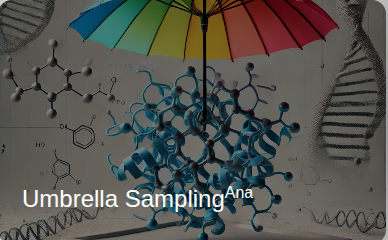
Umbrella Sampling module

10Umbrella Sampling

ScienceEnhanced-sampling module computing potential-of-mean-force / binding free-energy profiles via steered MD plus umbrella sampling and WHAM analysis.
EaseAutomated SMD-pulling and sampling-window setup, inside the same guided workflow as SimAna.
USPA quantitative free-energy check beyond a docking score — the rigor step before you commit wet-lab budget.
Watch it in action
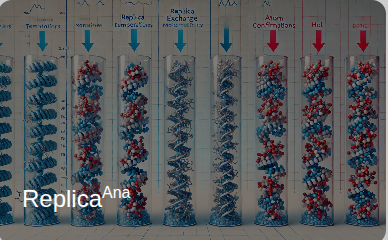
Replica Exchange MD module

11Replica Exchange MD

ScienceEnhanced-sampling MD technique that exchanges replicas across conditions (e.g. temperature) to escape local energy minima that trap standard MD runs.
EaseSame no-command, guided setup as the rest of the MD suite.
USPRounds out Analogue's sampling toolkit for systems where standard MD gets stuck.

Newest module in the suite — ask us for the latest validation notes.

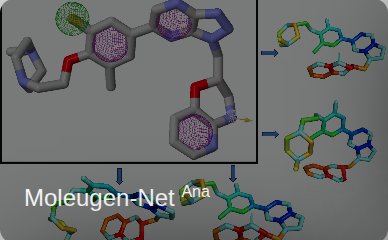
MoleuGen-NetAna module

12MoleuGen-NetAna

ScienceGenerative model that proposes new candidate SMILES from an input compound set — pretrained on ChEMBL, or train your own.
EaseGenerate a batch of candidate molecules in one click from an existing library.
USPThe pretrained-model option removes the "cold start" of training a generator from scratch.
Watch it in action

Platforms 02–05 — Standalone AI Products

Four purpose-built platforms beyond Analogue

Each ships as its own product — ADMET, toxicity, generative chemistry and fragment optimization — and each can be licensed on its own or bundled into the Growdea Discovery Suite.

Platform 02

ADMET-Vault

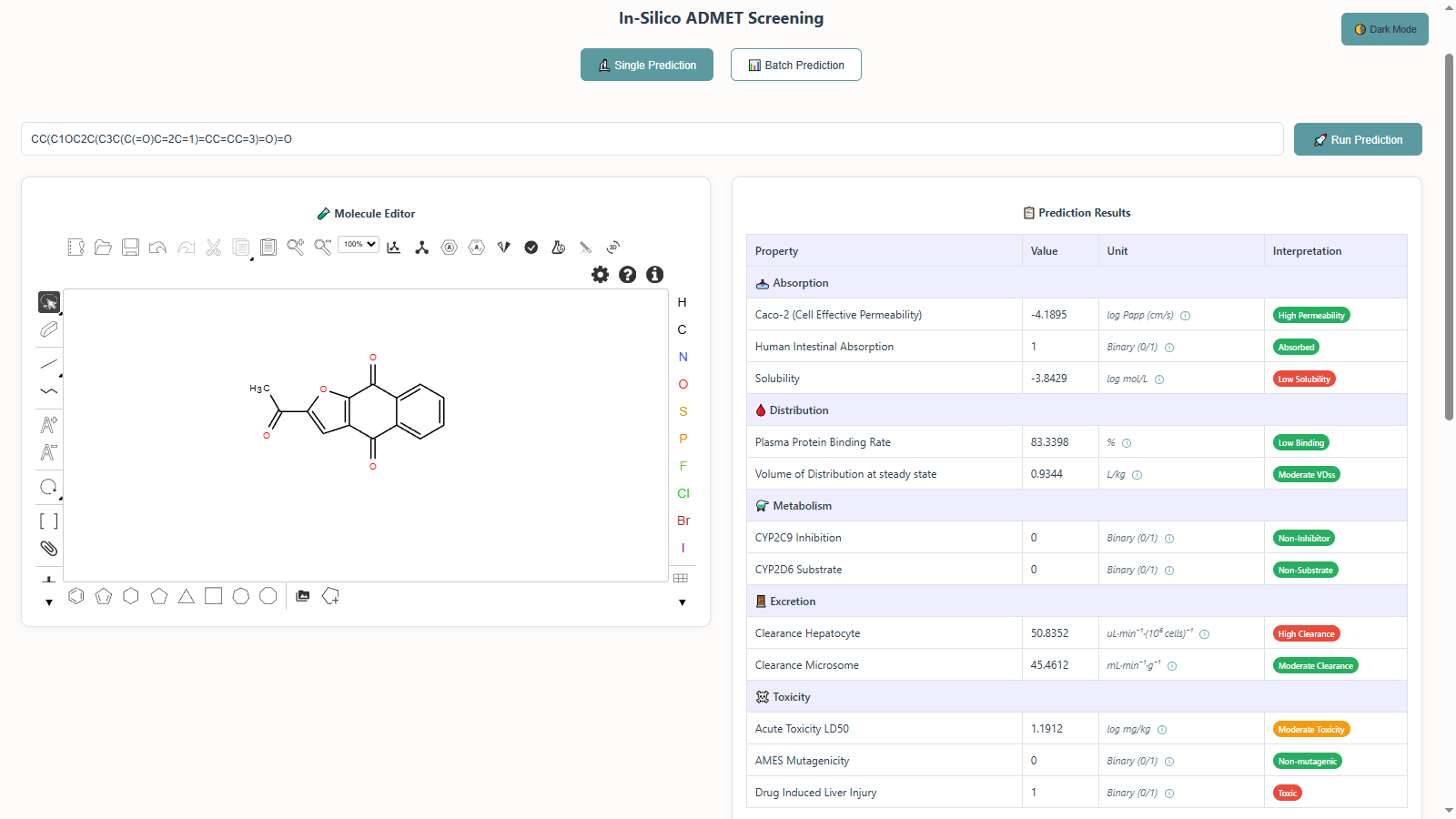
Draw a molecule or paste a SMILES string and screen it across 12 ADMET endpoints — absorption, distribution, metabolism, excretion and toxicity — benchmarked directly against the distribution of FDA-approved drugs, not an abstract score.

Ease of use
  • Web "Molecule Editor" — draw or paste SMILES, Single or Batch Prediction, CSV export
  • Visual reference bars show exactly where your compound sits vs. the FDA-approved range (mean ± SD)
USP
  • Ranks under 5 on the TDC (Therapeutic Data Commons) Leaderboard across 12 properties
  • Real-time "structure refinement cycles" — edit the molecule, recalculate instantly, watch properties move back into range
Case study: adding one −OH group moved Caco-2 permeability, solubility and 3 other properties into the FDA-approved band in a single iteration
ADMET-Vault in-silico ADMET screening interface

Live product interface — In-Silico ADMET Screening

ADMET-Vault — product walkthrough

Platform 03

BioTox — powered by the OctaTox toxicity graph

AI toxicity prediction — neurotoxicity, cardiotoxicity, hepato-, nephro- and pulmonary-toxicity and more — built on genetically diverse human iPSC-derived cell assays, organ-on-chip data and high-throughput screening, not animal models. Under the hood, BioTox runs on Octa-Graph and Octa-ADR: a toxicity-specific knowledge graph and drug-interaction/adverse-event database that ground every prediction in curated, human-derived evidence.

Ease of use
  • Deploys on your own server and integrates into existing screening workflows
  • 3-class, explainable output (e.g. Non- / Moderate- / fully Toxic) shown with molecular initiating events and substructure highlighting — never a bare pass/fail score
USP
  • Toxicity-specific knowledge graph (Octa-Graph) with 2.4M+ relationships
  • Trained on human-derived data rather than rodent models; aligned with the FDA Modernization Act 2.0 and the EU's non-animal-testing push
  • Explainable-AI layer adds applicability-domain checks and structural-similarity search; customizable to phenotypically distinct populations
The problem it targets: 96% of drugs that pass animal testing still fail in human trials Random Forest neurotoxicity model: Train AUROC 0.83 / Test AUROC 0.69, validated against FDA-approved and withdrawn drugs
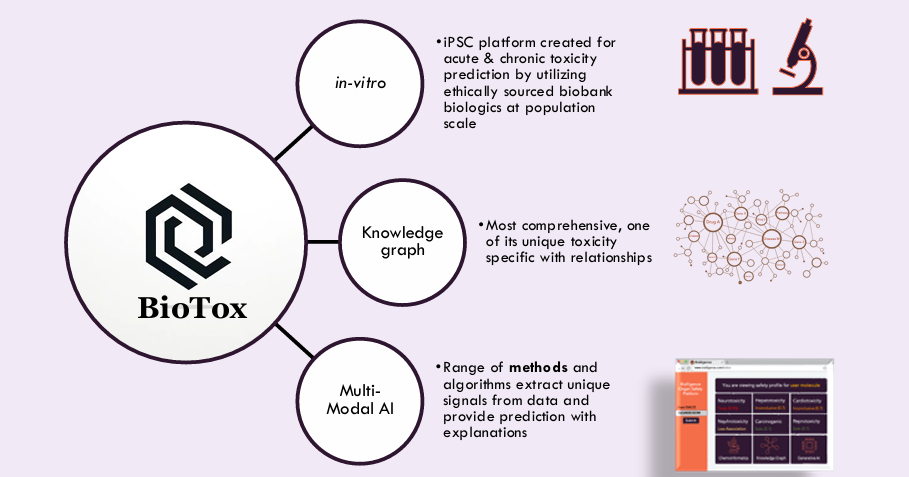
BioTox platform concept: in-vitro, knowledge graph, multi-modal AI

In-vitro data + toxicity knowledge graph + multi-modal AI

Platform 04

GrowGen

A generative AI molecule designer — a decoder-only Transformer combined with reinforcement learning (REINFORCE) — for property-conditioned de novo molecule generation, benchmarked against 7 competing generative models.

Ease of use
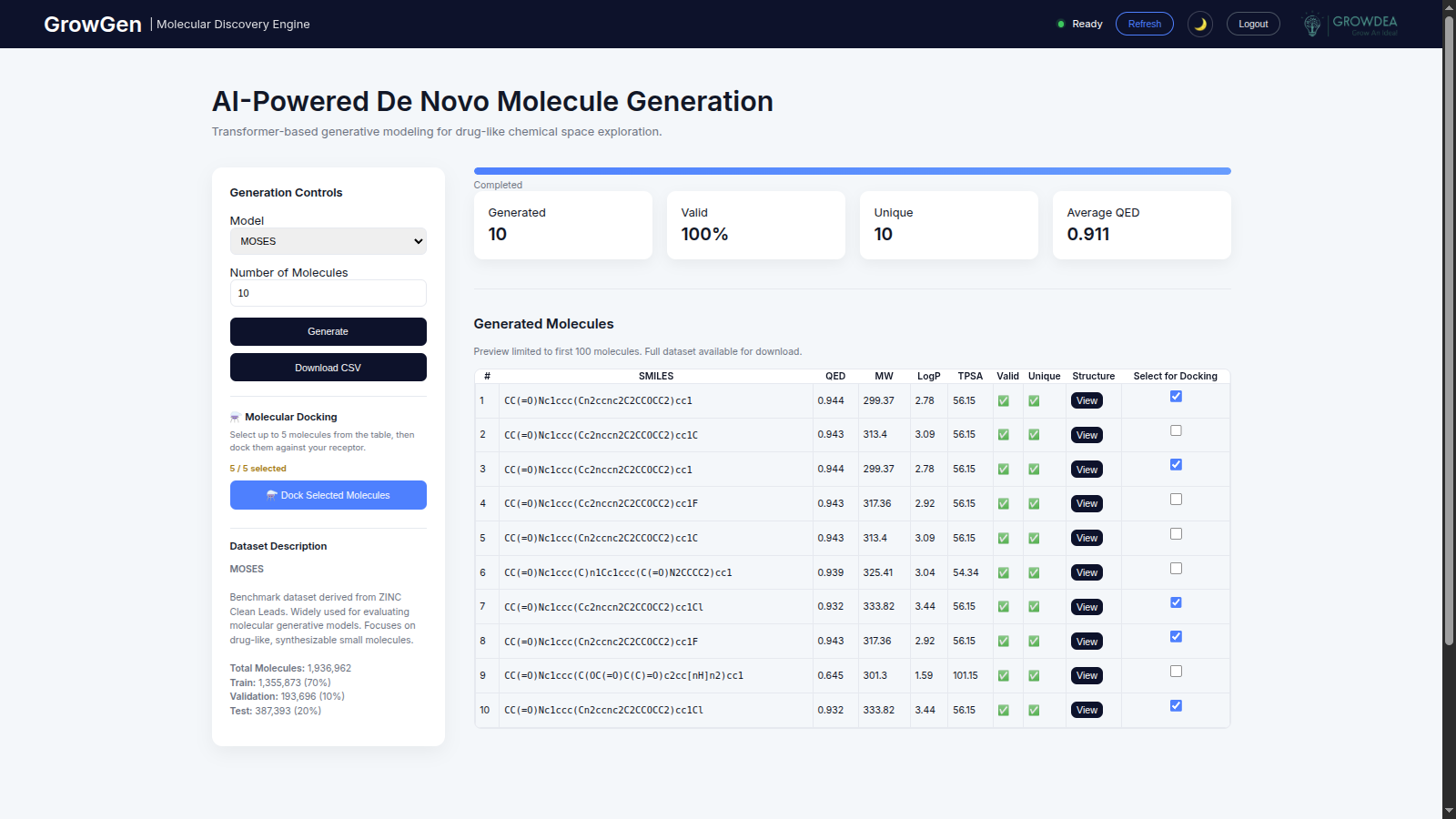
  • Pick a benchmark model (GDB13rand / MOSES / ZINC), set a molecule count, hit Generate
  • Validity, uniqueness and QED scored live; hits export straight into molecular docking
USP
  • >80% validity, >90% uniqueness, >99% novelty across all three benchmark datasets
  • Best-in-class QED (0.85) on ZINC against GCPN, JTVAE, MolGPT, MolGAN, GraphDF, LSTM and MolDQN
  • Avoids the mode-collapse failure seen in GAN-based competitors (MolGAN drops to 0% uniqueness on ZINC)
RL fine-tuning lifts average QED from ~0.45–0.55 to ~0.65–0.80 while keeping validity above 80%
GrowGen AI-powered de novo molecule generation interface

Live product interface — AI-Powered De Novo Molecule Generation

GrowGen — product walkthrough

Platform 05

iFrag

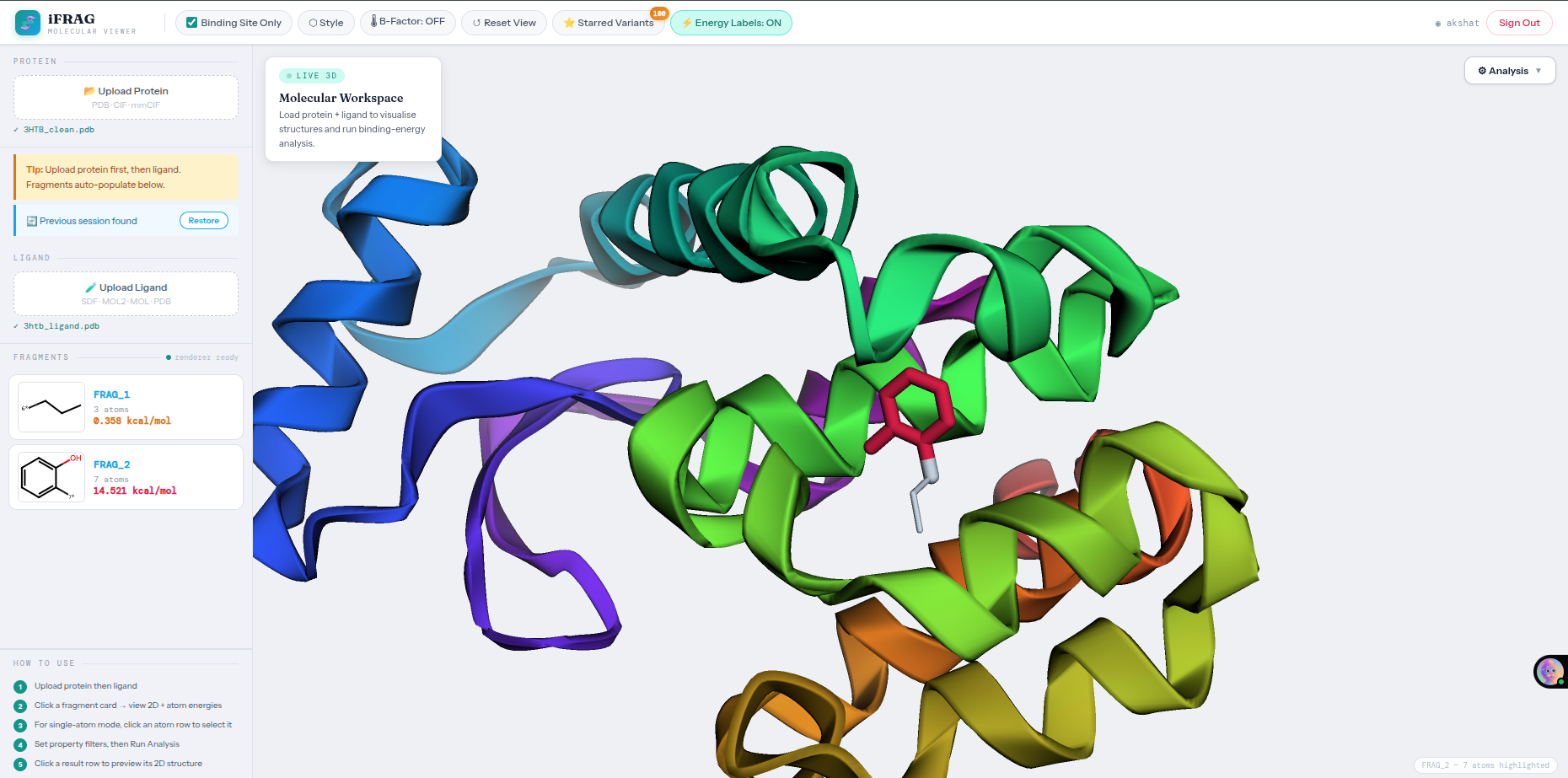
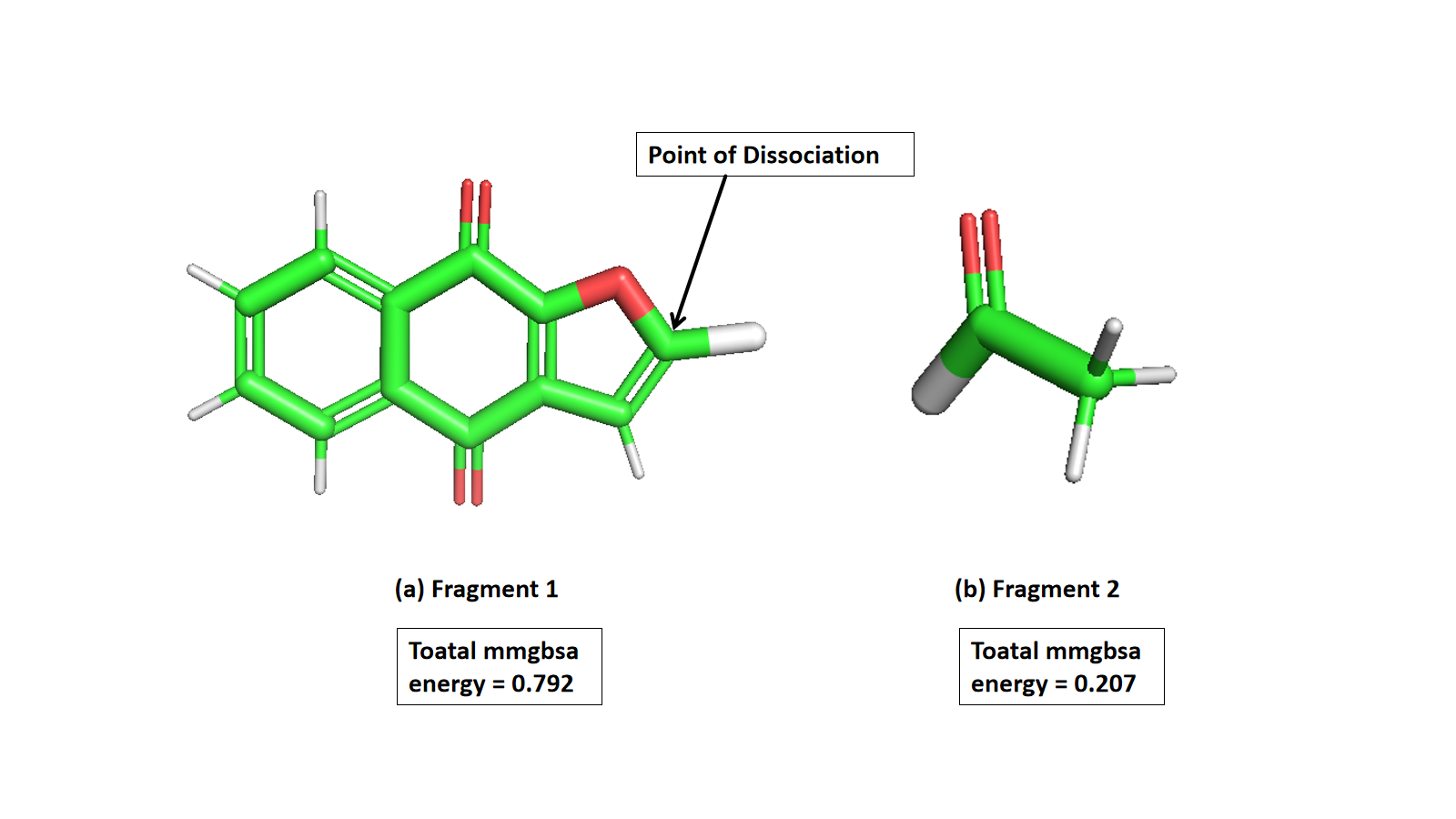
Structure-guided, fragment-based lead optimization. Given a docked complex, iFrag decomposes the ligand's binding energy per fragment, flags the weak one, profiles its pocket-residue environment, and screens a fragment library for stronger replacements.

Ease of use
  • Fully automated once you supply a docked complex — energy mapping, fragmentation and residue profiling run without manual steps
  • Returns a ranked top-100 replacement-fragment list automatically
USP
  • Screens a 708,687-fragment library
  • Classifies every pocket contact by chemical type (hydrophobic, H-bond, salt bridge, π-cation) — interaction-guided, not generic similarity matching
iFrag molecular viewer interface

Live product interface — iFrag Molecular Viewer

iFrag fragment energy decomposition diagram

iFrag — product walkthrough

Proof, Not Just Claims

Two published case studies, both wet-lab confirmed

Client names below are anonymized per Growdea's published case-study material — the workflows and numbers are reported as-is.

Case study — hit identification, neuronal-disorder target

1,003 compounds → 4 wet-lab-confirmed hits, 2 better than standard-of-care

  1. 1,003-compound library virtually screened against 9 targets
  2. Top ~50 hits per target shortlisted by scoring function across 7 targets
  3. GNN model predicted IC50 for the top 10 compounds (range 3.25–3.35 nM)
  4. 4 compounds taken to wet-lab testing — all 4 came back bioactive; 2 outperformed the market-standard comparator
Reported result: 30–40% shorter discovery timeline, 50–60% cost savings in early hit identification
Case study — therapeutic peptide vs. protein dimer

11 candidate interfaces → 6 peptides modelled → 2 confirmed binders in 6–7 months, start to wet lab

  1. AI identified 11 candidate dimer-interface regions on the target
  2. Protein–protein docking generated 1,100 total poses
  3. Kd predicted for 6 candidate peptides (1.1×10⁻⁹ M to 4.0×10⁻⁹ M)
  4. Fluorescence assay confirmed 2 peptides bound significantly at 1:10 concentration
Only 6 peptides needed synthesis and testing — full process, including wet-lab validation, completed in 6–7 months

"Avinash and his team Growdea, worked for us to analyze the pathogenicity of protein using molecular modeling and machine learning techniques. They showed a high level of expertise and dedication to their work throughout the project. I highly recommend Growdea to those looking for assistance in computational biology and machine learning."

Sherie Ma, PhD — CEO, GenieUs Genomics, Australia

"We were able to finish the entire process, including wet lab testing, within a span of 6-7 months. This achievement was made possible by the utilization of advanced computational/AI techniques throughout the process."

CEO — Pluto Biotech (client name anonymized per source case study)

Deployment

Single workstation or lab-wide server — your choice

Local Machine

A dedicated, single-user GPU workstation with up to 4 GPUs, pre-installed and shipped by Growdea. Best for an individual lab or PI group getting started with computational screening.

Local Server

Multi-user, client–server deployment on your own infrastructure, licensed per seat, scaling up to 10 GPUs. Best for a department or CRO running the suite across several research groups.

Growdea Discovery Suite bundles Platforms 1–5 (Analogue, BioTox/OctaTox, ADMET-Vault, iFrag, GrowGen) at a 25% discount for single-user licenses and 30% for a 4-user server; additional server seats get a further 20% discount per platform. Suite and single-Analogue purchases include 2-day onsite training and up to 40 hours/year of live support; other single-platform purchases include the same hours delivered online.

Peer-Reviewed Evidence

Published research, not just product claims

Extracted from growdeatech.com's own Publications and Citations pages. DOIs were independently verified against Crossref and publisher records where the source site didn't expose them directly.

Research Publications

By the Growdea team, as listed on growdeatech.com/publications.

  1. DecoyFinderNetAna: Application of Graph Convolution Neural Networks for Accurate Classification of True Small Molecule Binders from their Decoys2026 10.2174/0115734099429333260113070143
  2. Binding-NetAna: Rescoring of docked protein-ligand complex using structural parameters by applying graph convolution neural network2026 10.1007/s13721-026-00784-6
  3. Molecular Insights into Anabaenopeptin-Mediated Inhibition of Protein Tyrosine Phosphatase B in the Mycobacterium tuberculosis Complex2026 10.1021/acsomega.5c01567
  4. ADMET-Vault: an interactive framework for real-time ADMET prediction and molecular optimization2026 10.1007/s10822-026-00816-3
  5. Mechanistic explanation of activation and inhibition of crucial enzymes involved in melanin production2025, Journal of Computational Biophysics and Chemistry 10.1142/S2737416524500753
  6. Integrated virtual screening and compound generation targeting H275Y mutation in the neuraminidase gene of oseltamivir-resistant influenza strains2025, Molecular Diversity 10.1007/s11030-025-11163-0
  7. Targeting atherosclerosis by inhibiting CD40–CD40L Protein–Protein interaction via novel protein design strategies2025 10.1016/j.bbrc.2025.152603
  8. Higher concentration of trehalose dihydrate stabilizes recombinant IgG1 under forced stress conditions2025, Journal of Pharmaceutical Sciences 10.1016/j.xphs.2024.12.017
  9. Differentiating stable and unstable protein using convolution neural network and molecular dynamics simulations2024 10.1016/j.compbiolchem.2024.108081
  10. Machine learning optimization approach to design multi-epitope Marburg vaccine construct2024, Biosciences Biotechnology Research Asia, 21(4), 1463–1484 10.13005/bbra/3318
  11. Identifying potential compounds from Bacopa monnieri (brahmi) against coxsackievirus A16 RdRp targeting HFM disease (tomato flu)2023, preprint 10.21203/rs.3.rs-2858148/v1
  12. Pharmacophore screening to identify natural origin compounds to target RNA-dependent RNA polymerase (RdRp) of SARS-CoV22022, Molecular Diversity 10.1007/s11030-021-10358-5
  13. RNA dependent RNA polymerase (RdRp) as a drug target for SARS-CoV22022 — DOI not exposed by source; not confidently resolved via Crossref
  14. Dimerization of SARS-CoV-2 nucleocapsid protein affects sensitivity of ELISA based diagnostics of COVID-192022, preprint 10.1101/2021.05.23.445305
  15. Synergistic Effects of Natural Compounds Toward Inhibition of SARS-CoV-2 3CL Protease2021 10.1021/acs.jcim.1c00994
  16. Structure-based design of small peptide ligands to inhibit early-stage protein aggregation nucleation2020 10.1021/acs.jcim.0c00226
  17. Efficient toxicity prediction via simple features using shallow neural networks and decision trees2019 10.1021/acsomega.8b03173

Citations of Analogue by Users

Independent, peer-reviewed publications citing Growdea's platforms, as listed on growdeatech.com/citations.

  1. Alkhatabi, H. A., & Alatyb, H. N. (2024). In Silico Design of Peptide Inhibitors Targeting HER2 for Lung Cancer TherapyCancers, 16(23), 3979 · IF 4.5 10.3390/cancers16233979
  2. Suyash, S., Mishra, A., & Tembre, M. K. (2024). Mechanistic Explanation of Activation and Inhibition of Crucial Enzymes Involved in Melanin ProductionJournal of Computational Biophysics and Chemistry, 1–20 · IF 2.4 10.1142/S2737416524500753
  3. Sarin, D., Chakraborty, D., Sreenivasan, S., Mishra, A., & Rathore, A. S. (2025). Higher concentration of trehalose dihydrate stabilizes recombinant IgG1 under forced stress conditionsJournal of Pharmaceutical Sciences · IF 3.7 10.1016/j.xphs.2024.12.017
  4. Suyash, S., Khan, W. H., Maitra, P., Jangid, V., Punia, P., & Mishra, A. (2024). Machine Learning Optimization Approach to Design Multi-Epitope Marburg Vaccine ConstructBiosciences Biotechnology Research Asia, 21(4), 1463–1484 · IF 1.0 10.13005/bbra/3318
  5. Varude, P., & Satish, D. (2024). Integrative Computational Design of PD-L1 Inhibitors Utilizing MD Simulations and DFT StudiesJournal of Computational Biophysics and Chemistry · IF 2.4 10.1142/S2737416524500881
  6. Kizhakethil, R. V., Varma, A. K., Barage, S., Rameshkumar, N., Nagarajan, K., Kumar, A. W. S., & Kamble, S. (2025). Repercussions of the calpain cleavage-related missense mutations in the cytosolic domains of human integrin-β subunitsInternational Journal of Molecular Sciences · IF 4.9 10.3390/ijms26094246
  7. Khan, W. H., Khan, N., Tembre, M. K., Malik, Z., Ansari, M. A., & Mishra, A. (2025). Integrated virtual screening and compound generation targeting H275Y mutation in neuraminidase geneMolecular Diversity · IF 3.8 10.1007/s11030-025-11163-0

Four of these are Growdea-team authored papers (also listed at left) that the company cross-lists as user citations of its own platform.